
Oman needs more local IVF capacity, and Inzint brings directly relevant delivery experience: we built ZoeyMed, an IVF health management information system (HMIS) connecting appointments, patient records, treatment protocols, laboratory workflows and inventory.
A fertility centre is easy to picture as a laboratory, a theatre and a consultation room. But capacity is not measured by rooms alone. It is measured by how many couples can move safely through diagnosis, treatment, laboratory work and follow-up, and whether the people and systems around that journey can learn as demand changes.
That question matters more as Oman’s demographic picture changes. The National Centre for Statistics and Information’s Statistical Year Book 2026 reports an overall total fertility rate of 1.9 births per woman in 2024, compared with 2.6 in 2020. The direction is clear: fewer births per woman than only a few years earlier.
That headline should prompt serious planning. It should not prompt a false diagnosis.
A falling fertility rate is a demographic signal. Infertility is a medical condition. They are related to family formation, but one does not prove the other.
Proven IVF software delivery
Inzint has already built an IVF HMIS
ZoeyMed is not a hypothetical capability. Inzint designed and delivered its product experience, system architecture, backend, frontend, data layer and testing. That experience gives Inzint a credible role in building the digital systems needed as Oman expands fertility infrastructure and trains specialist teams.
Start with the distinction the numbers require
A country’s total fertility rate describes births across the population. It can change because people marry later, postpone children, choose smaller families, face housing or economic pressures, or because the population mix changes. Infertility, by contrast, has a clinical definition connected to not achieving pregnancy after a period of regular unprotected intercourse.
The World Health Organization estimates that about one in six adults globally experiences infertility during their lifetime. That figure demonstrates the scale of fertility care as a global health need. It is not an Oman prevalence estimate.
The research available for this article did not identify a national population survey measuring infertility in Oman. A recent study of 259 Omani couples attending a tertiary infertility clinic found both female and male factors among the patients it examined. That is useful clinical evidence, but because every participant was already seeking infertility care, it cannot tell us how common infertility is across Oman.
The honest position is therefore twofold: Oman’s fertility rate has fallen, and Oman still needs better national evidence about infertility demand. Expanding care and improving the data should happen together.
Oman has already taken an important first step
On 14 February 2024, the Ministry of Health opened the first fertility centre in Oman’s government health sector at Al Wattayah Obstetrics and Gynecology Complex under Khoula Hospital.
The Ministry said the centre would receive referrals from government hospitals and health complexes across all governorates, as well as urology, reproductive endocrinology, endocrine and oncology services. At opening, it aimed to receive and treat 1,000 cases in its first year and 1,500 in its second. Those were service ambitions announced at launch, not published results, but they reveal the breadth of the referral network the centre was designed to serve.
The opening changed the public-sector starting point. The next question is how Oman builds on it: additional access where evidence supports it, a deeper specialist workforce, coordination with private providers, and an operating model capable of growing without fragmenting.
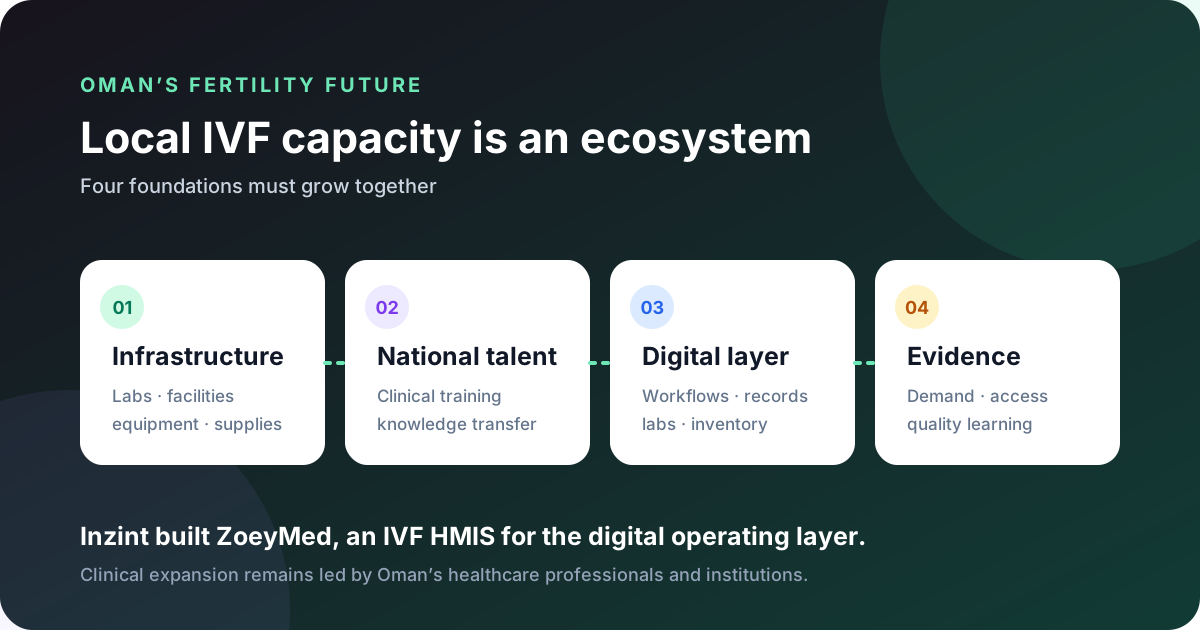
IVF capacity has four foundations
When people say “expand IVF capacity”, the conversation often moves directly to equipment and facilities. Infrastructure is essential, but sustainable capacity has four connected foundations.
1. Clinical and laboratory infrastructure
Consultation rooms, procedure facilities, controlled laboratory environments, storage, equipment, supplies and maintenance create the physical ability to deliver care. Expansion should follow measured demand and service geography rather than an assumed national patient count.
2. Specialist people and training
Fertility care depends on multidisciplinary expertise: reproductive-medicine clinicians, embryology professionals, nursing teams, andrologists, laboratory staff, counsellors, pharmacists and operational teams. Oman’s official fertility-centre standards set specific qualification and experience requirements for key roles. A building cannot become capacity faster than its people can be trained, supervised and retained.
3. A dependable digital operating layer
An IVF journey crosses appointments, treatment stages, medication protocols, laboratory timings, patient records and inventory. If each function lives in a different spreadsheet or disconnected product, adding rooms can increase activity while also increasing coordination risk.
The software layer should help authorised teams see the same treatment context, apply agreed workflows, control access, trace changes and know what requires attention next. It should support the clinical operation; it should not make clinical decisions or pretend to replace specialist judgement.
4. Evidence and quality learning
Capacity planning needs consistent definitions and reporting: referrals, waiting time, cycles started, cancellations, age bands, outcomes and reasons patients cannot proceed. The research report found no public national ART registry or comprehensive Oman-wide outcome dataset. That gap makes it harder to locate unmet need, compare access or plan the next unit responsibly.
These four foundations reinforce each other. Infrastructure creates places to deliver care. Training creates the capability to use them. Software coordinates the work. Data shows whether the system is reaching people and where it needs to improve.
Training and software should be designed together
Workforce development is often treated as a course that happens before a new service launches. In practice, training continues inside the operation.
A configurable system can make approved pathways visible at the point of work, define responsibility between teams, and help new staff understand the sequence surrounding their task. It can give supervisors a consistent view of exceptions and help a service refine its process without relying on private notes or one experienced person’s memory.
That does not mean turning clinical protocols into inflexible software. Medicine requires professional judgement, and protocols change. The right design separates stable safety and record-keeping requirements from configuration that authorised clinical leadership can maintain.
For an expanding ecosystem, this also helps knowledge move. A public centre, regional referral service, private provider or academic training partner may have different responsibilities, but common data definitions and clear handoffs make collaboration more practical.
The system should answer operational questions, not merely store forms
A local IVF platform earns trust by helping teams answer concrete questions:
- Where is each referred couple in the pathway, and what is the next authorised action?
- Which time-sensitive laboratory or medication tasks require attention?
- Can the relevant clinician and laboratory team see the same current treatment context?
- Are supplies available for scheduled activity, and can stock changes be traced?
- Which access role viewed or changed a sensitive record?
- Where are waiting times growing, and at which stage do cases pause or leave the pathway?
- Can agreed, de-identified service indicators be reported without rebuilding the dataset by hand?
Those questions connect patient experience, workforce efficiency, governance and capacity planning. They are also why fertility software is more demanding than a generic appointment calendar.
What ZoeyMed proves and what it does not
Inzint’s contribution to this conversation comes from a delivery record that includes ZoeyMed, an IVF clinic management platform built for a fertility clinic outside Oman between August and December 2024.
ZoeyMed connected appointment scheduling, patient records, treatment protocols, laboratory workflows and inventory in one web platform. Inzint’s documented scope covered product UX, system architecture, full-stack development and testing, using React, Redux, Node.js, Fastify, MongoDB and AWS.
The relevant capability is not simply “we built clinic software”. It is the ability to sit with domain specialists, identify the relationships inside a multi-stage workflow, translate them into a shared data model, separate application concerns, protect sensitive records and test recognisable journeys across the system.
The engineering evidence
The authoritative ZoeyMed engineering case study on Inzint.com documents the architecture, state-management approach, data decisions, testing and scope boundaries.
ZoeyMed was not built for Oman. It does not prove knowledge of an individual Oman provider’s protocols, infrastructure or legal obligations, and software delivery is not clinical training. What it does establish is relevant engineering experience for one part of the capacity problem: the digital operating layer beneath a specialised IVF workflow.
A practical expansion sequence for the ecosystem
Oman Vision 2040 calls for a healthcare system with international standards, qualified national talent, and technology-driven medical systems and services. IVF capacity is a useful place to join those priorities rather than pursue them as separate projects.
Map demand and the current referral journey
Start with evidence from public and private providers: referral sources, waiting stages, patient geography, available services, staffing constraints and the points at which people seek care elsewhere. Do not estimate national infertility prevalence from clinic samples.
Design the workforce and operating model
Define the multidisciplinary roles required for each service level, the training and supervision pathway, and which cases remain centralised or can be supported regionally. Infrastructure plans should be paced to qualified-team availability.
Pilot the digital workflow with the service
Configure the pathway with the clinicians, embryology and nursing teams who will use it. Test normal journeys and difficult exceptions. Integrate only with verified systems and avoid claiming interoperability before the interfaces are known.
Measure, learn and expand
Agree a small set of service measures before launch, with privacy and governance built in. Use actual demand, waiting-time and outcome data to decide whether to expand a unit, change a referral path, add training capacity or improve an existing workflow.
Inzint’s role in that future
Inzint can help fertility providers and health-system partners map operational workflows, design the platform architecture, connect scheduling, treatment, laboratory and inventory processes, implement role-aware access, support structured reporting and build software that can evolve with authorised clinical practice.
We would do that as a technology partner to clinicians, embryologists, health administrators, training institutions and compliance specialists, not in their place.
The most useful first conversation is not about buying a predetermined product. It is about where capacity is constrained today and whether workflow, data or system fragmentation is part of that constraint. If you are planning fertility-service expansion in Oman, talk to the Inzint Oman team about the digital operating layer that the clinical ecosystem will need.
Sources and evidence boundaries
- National Centre for Statistics and Information, Statistical Year Book 2026: Oman fertility-rate series.
- Oman Ministry of Health, “Health Opens Fertility Center”: opening, referral sources and announced capacity aims.
- World Health Organization infertility prevalence estimates: global context only.
- Oman Medical Journal tertiary-clinic study: clinic cohort only, not national prevalence.
- Oman Vision 2040, Health Priority: national talent and technology-enabled healthcare direction.