
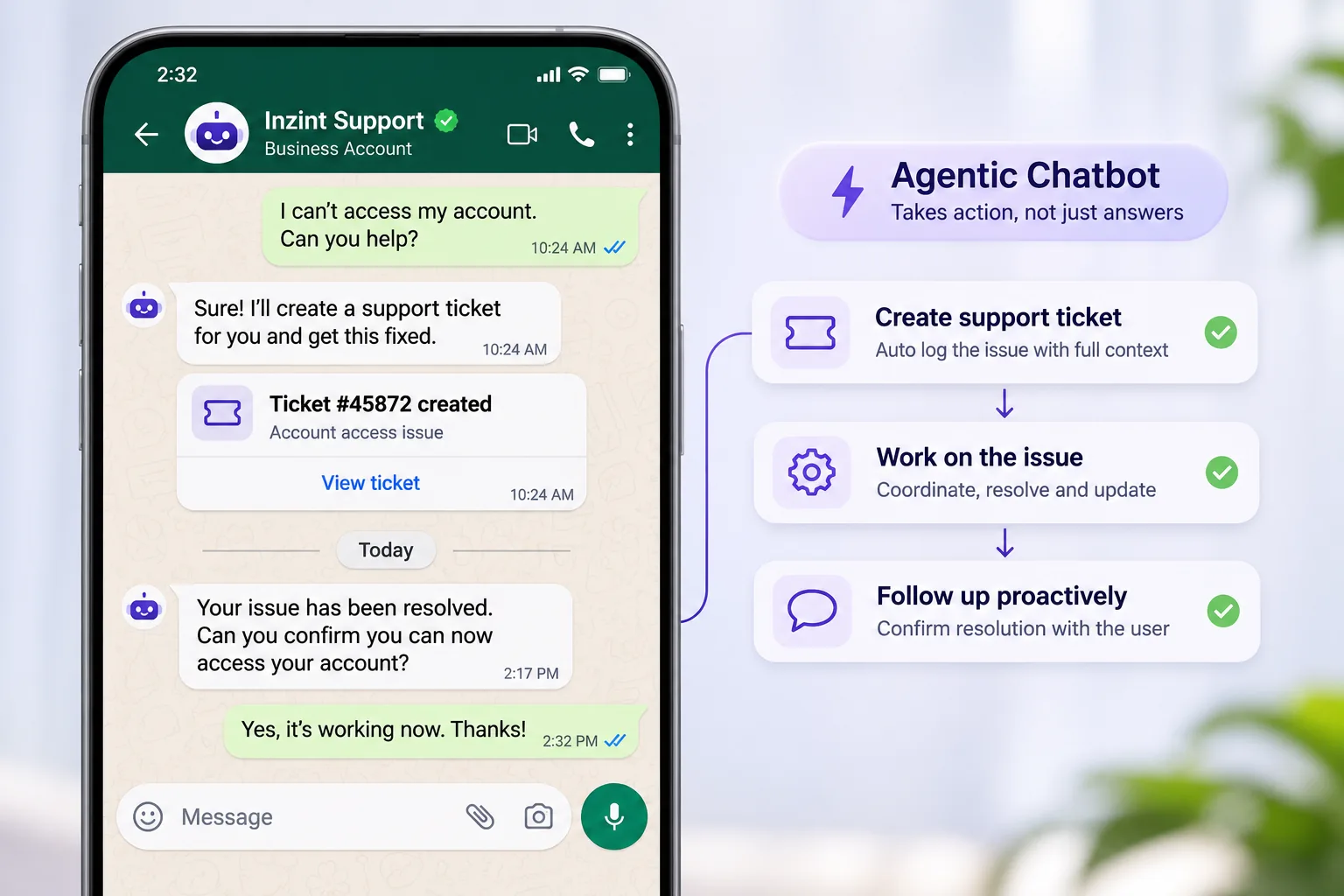
Ask most chatbots a real question and you get a polite paragraph and a dead end. "I'm sorry, please contact our support team." An agentic chatbot is the one that does the thing instead: it raises the ticket, looks up the order, books the slot, logs the lead in your CRM, and comes back to the customer when it is done. That difference is the whole value.
Key Takeaways
- Answering is a feature. Acting on the customer's behalf is the product
- The jobs an agentic bot takes end to end: support tickets, order status, bookings, lead capture
- Why the same bot that handles support is usually your best lead generator
- It has to live where Omani customers already are: WhatsApp, Instagram, your website
- English, Omani Arabic and voice notes, handled natively rather than translated
- Oman's Personal Data Protection Law, and how to stay inside it
- Where the bot should stop and a human should take over
🤖 Answering Is a Feature. Acting Is the Product
The first generation of business chatbots was a search box with manners. You trained it on your FAQs, it matched a question to an answer, and anything outside that list became "let me connect you with our team." Useful, but it moved nothing. The work still landed on a person.
An agentic chatbot is built the other way round. It is given tools, not just text: permission to create a record in your helpdesk, read an order from your ERP, check availability in a calendar, write a lead into the CRM, and send a follow-up message later. When a customer says "I can't access my account," it does not look for a matching paragraph. It opens a ticket with the full conversation attached, tells the customer the reference number, and messages them again when the issue is closed.
The test is simple: at the end of the conversation, has something changed in one of your systems? If not, you have a search box.
That is also why an agentic deployment is a software project rather than a content exercise. The hard part is not the language model. It is the set of actions you are willing to let it take, the guardrails around each one, and the integrations into the systems that actually hold the answers.
🛠️ What an Agentic Chatbot Actually Does
In practice, the same assistant usually covers four jobs for an Oman business:
| Job | What a basic bot does | What an agentic bot does |
|---|---|---|
| Customer service | Answers the FAQ, then asks the customer to email support | Raises the ticket with full context, works the issue with your team, confirms resolution with the customer |
| Order and account queries | Explains how to check an order | Looks the order up, reports the real status, flags the delivery exception |
| Bookings and appointments | Lists opening hours | Checks the calendar, holds the slot, sends the confirmation and the reminder |
| Lead generation | Shows a contact form | Qualifies the enquiry in conversation, writes it to the CRM, routes it to the right salesperson |
None of this requires the bot to be clever about everything. It requires it to be reliable about a short, well-chosen list of actions. Most deployments start with three or four and grow from there.
📈 The Support Bot Is Usually Your Best Salesperson
Businesses tend to buy a chatbot to reduce support load and then discover that the bigger return is on the other side. The reason is timing. Someone messaging your WhatsApp at 9pm to ask whether you stock a part, deliver to Sohar, or have availability on Thursday is not a support ticket. They are a buyer, and right now most of those messages go unanswered until morning.
An agentic bot treats that conversation as a sale in progress. It answers the question, asks the one or two things your sales team always has to ask anyway, and writes a qualified lead into the CRM with the full transcript attached, so whoever picks it up in the morning is not starting from zero. Nothing sits unread in an Instagram inbox.
If you want the arithmetic on what those unanswered messages are worth, we went through it in the real cost of missed DMs, forms and calls.
💬 It Has to Work the Channels Omanis Actually Use
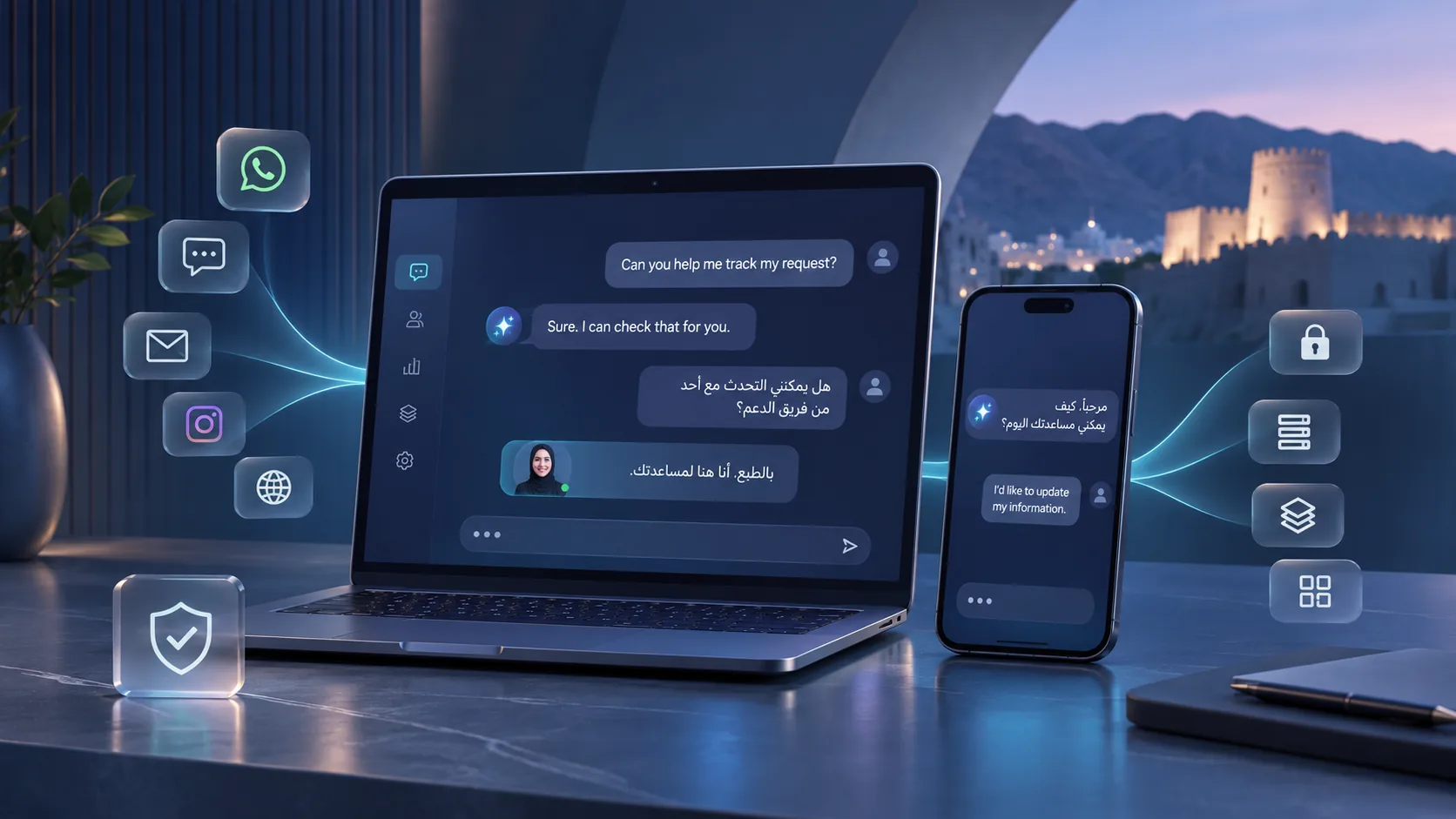
A chatbot that only lives in a widget in the bottom-right corner of your website is answering a fraction of your customers. In Oman, the conversation usually starts on WhatsApp, and it often starts on Instagram. Those are the channels where people already message businesses, and they are the channels where a slow reply costs you the sale.
So the deployment question is not "which channel do we put the bot on" but "how do we make it one assistant across all of them." That means:
- WhatsApp Business, on your official business number, with verified status, so the customer knows it is you.
- Instagram direct messages and comment replies, where retail and hospitality enquiries actually arrive.
- Your website, where the visitor is already reading about the product.
- Email and web forms, so an enquiry that comes in overnight is triaged rather than queued.
One brain, one set of actions, one memory of the customer. If a customer asks on Instagram and follows up on WhatsApp, the bot should not make them start again. We have written separately on connecting Instagram, WhatsApp and your store so the channels share a single source of truth.
🗣️ English, Omani Arabic, and Voice Notes
Language support is where a lot of chatbot deployments quietly fail in Oman. A bot trained on Modern Standard Arabic will handle a formal written enquiry and then fall over on the way people actually type, which is Omani dialect, often mixed with English in the same sentence, often abbreviated, often with no diacritics at all.
Three things have to be native rather than bolted on:
- English and Omani Arabic in the same conversation. Customers code-switch mid-sentence. The bot should not need to be told which language it is in, and it should reply in the one the customer used.
- Voice notes. On WhatsApp in Oman, a large share of customer messages are recorded, not typed. A bot that cannot listen to a voice note is offline for those customers. Ours transcribes the note, understands the dialect, acts on it, and can reply in voice if that suits the channel.
- Names, places and terminology. Omani place names, company names and product terms have to be recognised correctly, because a misheard delivery address is a failed delivery.
This is a training-data question rather than a model-size question, and it is the reason we test Arabic handling on real customer transcripts rather than on benchmark sentences. The same argument applies on the phone line, which we covered in why Standard Arabic alone often fails in real customer conversations.
⚖️ Built to Oman's Personal Data Protection Law
An agentic bot holds more customer data than a FAQ bot, because it reads records and writes them. That makes compliance a design requirement rather than an afterthought, and in Oman the relevant instrument is the Personal Data Protection Law, issued under Royal Decree No. 6/2022 and in force since early 2023.
In practice, four things keep a deployment inside it:
- A lawful basis for processing. Consent or contractual necessity for the personal data the conversation collects, captured at the point the conversation starts.
- Data residency. Transfers of personal data outside Oman are restricted. We deploy on in-country or on-premise infrastructure where that matters, so the question does not arise.
- Data minimisation and retention. The bot collects what the action needs and no more, and conversation logs have a retention period you set rather than one a vendor sets.
- Individual rights. Access, correction and deletion requests have to be answerable, which means knowing exactly where a given customer's conversation data sits.
A note on legal advice
This is a general operational overview, not legal advice. For a regulated deployment in banking, healthcare or government services, have your own adviser review the design against the PDPL before go-live.
If your sector requires the model itself to stay inside your building, that is a fully private self-hosted GPT rather than a chatbot deployment, and the two are often built together.
🤝 Where the Bot Should Stop
An agentic bot is more useful when its limits are explicit. The actions it can take should be a list you approved, each with a rule about when to escalate. A sensible starting boundary:
Good defaults for handoff
- Anything involving money moving beyond a standard order: refunds, credit notes, pricing exceptions.
- Complaints with emotional weight. A frustrated customer wants a person, and the bot should read that and route it fast.
- Anything the bot is not confident about. A clean "let me get a colleague" beats a confident wrong answer every time.
- Out-of-policy requests. The bot should know your policy well enough to recognise when something sits outside it.
Handoff should carry the whole conversation with it, so the customer never repeats themselves and your colleague never starts cold. Deciding which enquiries belong to the bot and which belong to a person is worth doing deliberately, and the same readiness questions apply on the phone line, which we worked through in is your business ready for an AI receptionist.
Where to Start
The deployments that work tend to start narrow. Pick the three enquiries that make up most of your inbox, give the bot the systems it needs to actually resolve them, measure how many conversations end without a human, and widen from there. The content side matters too: a bot can only answer cleanly from material that is written to be answered from, which is the argument in how to turn FAQs into better chatbot answers.
If you want to see what this looks like on your own channels, with your own systems behind it, our agentic chatbot service covers the build, and a short conversation with the team is usually enough to work out which three actions are worth automating first.