
Should Your Homepage Show Prices?
Showing a price is not about confidence, it is about matching the pricing format to how predictable your offer really is. A practical framework for choosing between exact prices, ranges, and quote-only pages.
A service page structured around problem, fit, process, deliverables, proof, and objections answers the questions buyers have before they call, so the call that happens is shorter and easier to close.
Practical reading on websites that get found, understood, trusted, and chosen.
Showing a price is not about confidence, it is about matching the pricing format to how predictable your offer really is. A practical framework for choosing between exact prices, ranges, and quote-only pages.
When nobody inside the business is responsible for content, enquiries, access, maintenance, or performance, a website does not fail loudly. It fails quietly, one missed lead and one overdue update at a time, until the cost shows up somewhere else entirely.
Slow intros, needless animation, confusing menus, dense text, weak headings, and buried proof are why visitors leave your site before they ever see the case studies, pricing, or testimonials that would have convinced them.
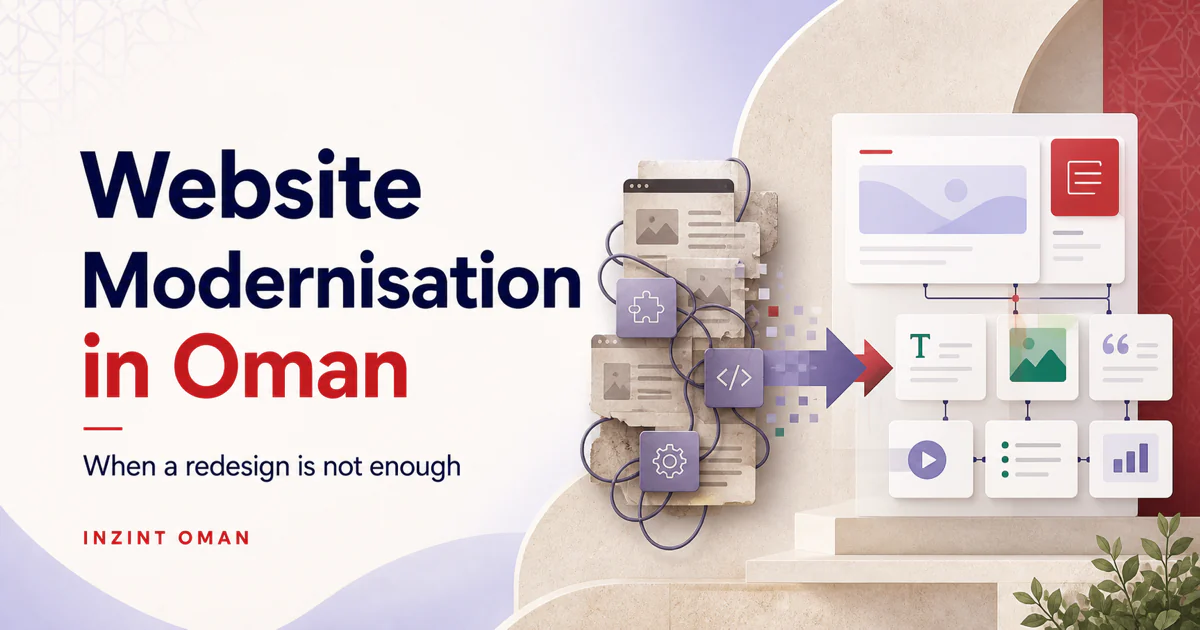
What Oman teams can learn from a complex publishing rebuild: preserve valuable content, reduce platform debt, plan multilingual growth, and launch without losing continuity.
Most homepages try to speak to every possible visitor at once, and end up connecting with none of them. Here is how to find your most valuable audience and build your homepage message around them first.
A contact form submission looks like a single event, but it actually triggers a five step chain of notification, response, record keeping, ownership, and follow up. Here is where that chain typically breaks, and how to check your own site.
A practical audit of the phone, form, email, WhatsApp, and map paths that decide whether a visitor reaches you or gives up, on desktop and on mobile.
A five-question test for what your homepage must communicate in the first ten seconds: what you do, who it's for, what result you deliver, why you're credible, and what to do next.
Growing traffic but no enquiries usually means a break in one of six places: mismatched traffic, an unclear offer, weak proof, a buried call to action, broken tracking, or slow follow-up. Here is how to find and fix it.
A polished homepage does not guarantee enquiries. These seven concrete signs show when a website has quietly turned into a static company profile instead of a system that attracts, qualifies, and routes potential customers, plus the single next step to fix it.
AI visibility is not a magic prompt trick. It comes from crawl access, clear facts, source-worthy pages, structured data, and content that adds real experience.
A beautiful website can still fail if it hides the offer, delays proof, loads slowly, or makes the next step feel risky.
When rankings drop after a redesign, the first job is not more content. It is fixing crawl, redirects, canonicals, page quality, and trust signals in the right order.
Ranking still matters, but a modern Oman website also has to be crawlable, fast, useful, quote-ready, and convincing enough to turn a visit into an enquiry.
Your website has to pass three tests: Google can find it, AI can explain it, and a real buyer can contact you without friction.
A website audit should not be a vague PDF. It should test speed, crawlability, content clarity, accessibility, schema, trust, and conversion risk with evidence.
We check SEO, speed, structure, AI readability, content clarity, and lead paths.
